

- 0 Comments
- By The Handyman Writer
- Home Maintenance & Repairs
TV wall mounting looks like a ten minute job until the drill goes into a London wall and something unexpected happens: soft mortar crumbles, the bit drops into a hollow void, or you hit timber where you expected brick. Getting the screen onto the wall is the easy part. Getting it up straight, at the right height, on fixings that will still hold in ten years and with no cables trailing down to the socket is where the time goes.
This guide is written for London homes, from Victorian terraces to new build flats. It covers what each wall needs, how high the screen should go, how to hide cables within the rules and what TV wall mounting costs.
The quick answer
TV wall mounting means fixing a bracket to the wall with fixings matched to the wall type and to the weight of the TV, then hanging the screen on it. On solid brick, standard masonry fixings are fine. On plasterboard, the bracket should go into the timber or metal studs, or into a timber board fitted behind the plasterboard. The centre of the screen should sit at roughly seated eye level, around 100 to 110cm from the floor in a typical living room. In London a standard job usually costs £90 to £200 in labour, with the bracket and any in wall cable work on top.
How to mount a TV on the wall in five steps
If you’re doing it yourself, this is how to mount a TV on the wall without nasty surprises.
- Check the TV. Find its weight without the stand and its VESA pattern, the spacing of the four holes on the back. Both are in the manual.
- Choose the bracket. Fixed brackets sit closest to the wall, tilting ones angle the screen down and full motion arms swivel. Pick one that matches the VESA pattern and is rated well above the TV’s weight.
- Find out what the wall is made of. Knock on it, run a detector over it and drill a small test hole if you’re unsure.
- Check for pipes and cables. Keep out of the areas directly above, below and beside sockets and switches, where cables are allowed to run.
- Mark, level and fix. Use a spirit level, fix the wall plate, attach the arms to the TV and lift it on with a second person.
Most of the work is in steps 3 and 4. The drilling itself takes minutes.
London wall types and what each one needs
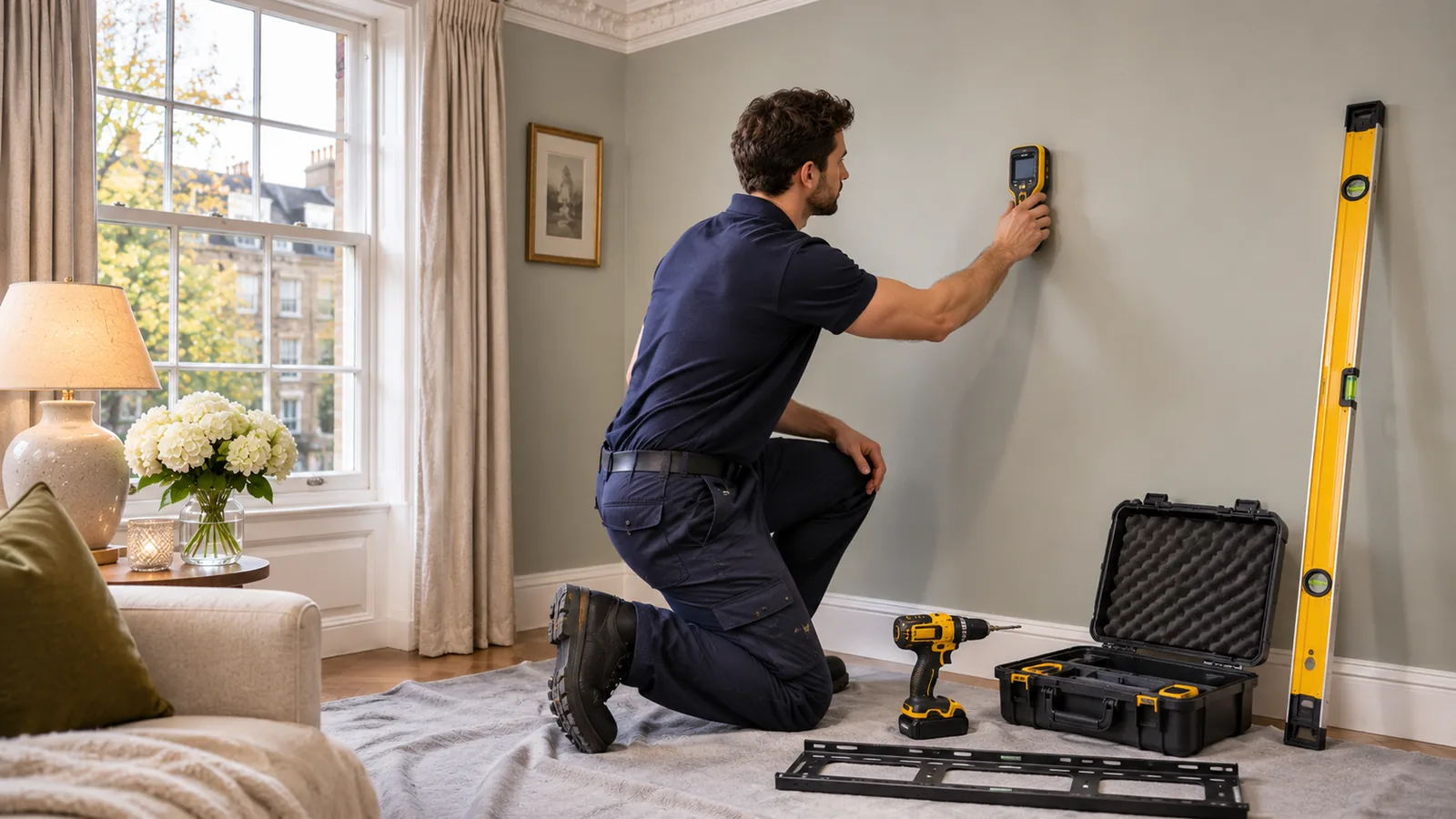
Wall type is the biggest single factor in TV wall mounting, and London’s housing is very mixed. A Georgian house in Fitzrovia, a 1930s mansion block in Marylebone and a new flat in King’s Cross can each need a different fixing.
| Wall type | Where you’ll find it in London | How to tell | What it needs | Watch out for |
|---|---|---|---|---|
| Solid brick | Georgian and Victorian terraces, chimney breasts, party walls | Hard knock; red dust when drilled | Masonry plugs or anchors in the brick, not the mortar | Crumbly lime mortar; flues in chimney breasts |
| Lath and plaster | Internal walls in pre war houses and mansion blocks | Uneven surface; drill hits thin wooden strips | Screws into the timber studs, or a board fixed across them | Old plaster cracking around holes |
| Plasterboard on timber studs | Loft conversions, extensions, modern partitions | Hollow knock; white dust | Screws into the studs; cavity fixings only for light TVs | Full motion arms on plasterboard alone |
| Metal stud partitions | New build apartments | Detector finds metal at regular spacings | Fixings made for metal studs | Wood screws won’t grip |
| Dot and dab | Houses and flats from the 1970s on | Solid in spots, hollow in others | Long fixings into the masonry, with spacers | Board cracking as bolts are tightened |
Wall mounting TV on plasterboard
Wall mounting TV on plasterboard is where most DIY jobs go wrong. UK plasterboard is usually 12.5mm thick, and an ordinary screw in it will pull out under real weight. Heavy duty cavity fixings help, but the safer route is to screw the bracket into the studs. If they aren’t where the bracket needs to go, a carpenter can fit a timber board between them and make good.
Avoid full motion arms on plasterboard unless the bracket goes into timber. When the arm is pulled out, the leverage on the top fixings is far greater than the TV’s weight.
Getting the screen onto the wall is the easy part. Getting it up straight, on fixings that will hold, is where the time goes.
What is the best height to mount a TV?
Height is the TV wall mounting decision people most often regret. The best height to mount a TV in a living room puts the centre of the screen at your eye level when you’re sitting down. On a standard sofa that is usually 100 to 110cm from the floor. If you can’t get the centre that low, try to keep the top of the screen no more than about 15cm above eye level.
| Room | Centre of screen from the floor | Bracket that suits it |
|---|---|---|
| Living room | 100 to 110cm | Fixed or tilting |
| Bedroom, watched from bed | 110 to 130cm | Tilting, angled down |
| Kitchen or dining area | 130 to 150cm | Tilting or full motion |
| Above a fireplace | Usually 130cm or more | Tilting, angled down |
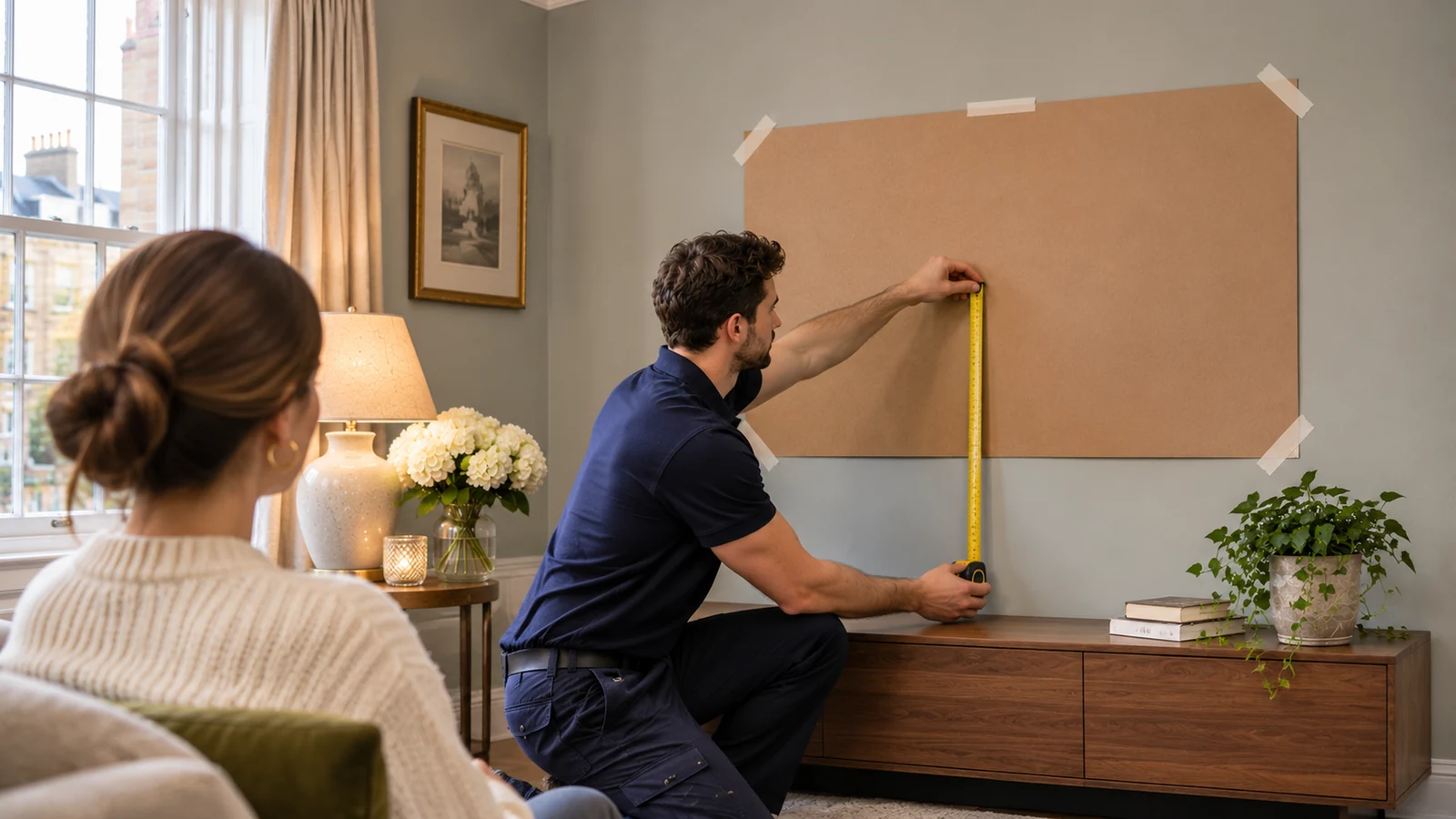
Above the fireplace is the spot everyone wants in a period living room, and it’s usually too high. If it’s the only wall, use a tilting bracket and keep the TV close to the mantelpiece. To test a height, tape a piece of cardboard the size of the screen to the wall and watch something from the sofa.
Hiding TV cables in wall cavities: what’s allowed
Hiding TV cables in wall cavities is what makes TV wall mounting look finished, but power and signal cables follow different rules.
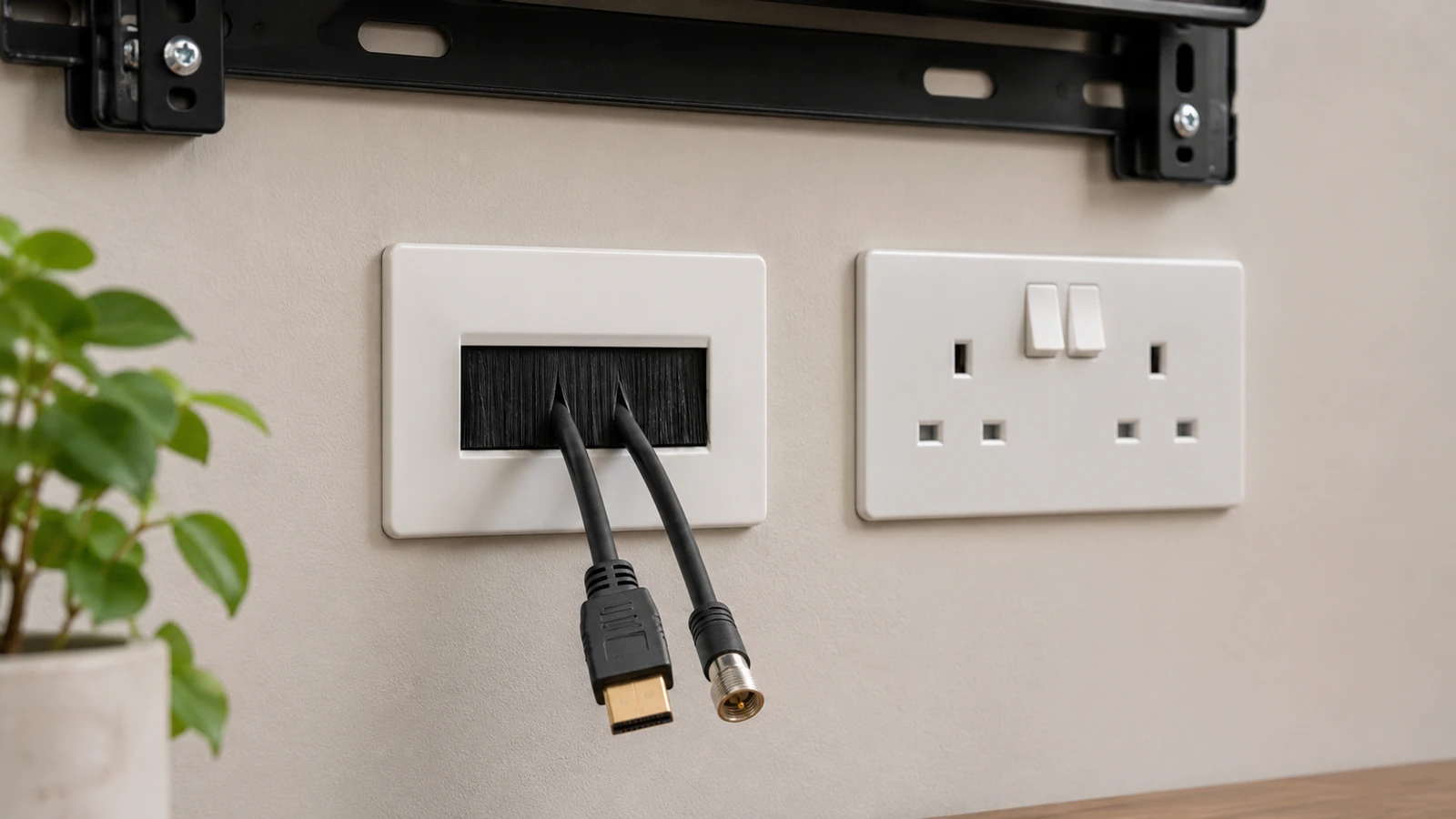
HDMI, aerial and network cables carry low voltage. They can run through the cavity between two cable outlet plates, one behind the TV and one near the TV unit.
The TV’s power lead is a flexible cord meant to stay visible, so don’t bury it in the wall. The proper fix is a new socket behind the TV. In England, adding a socket to an existing circuit in a living room is usually not notifiable under Part P, but it must still meet the wiring regulations (BS 7671) and be tested. Cables buried less than 50mm deep must run straight up, down or across from a socket or switch, and need RCD protection.
| Option | What it involves | Best for | Mess |
|---|---|---|---|
| Surface trunking, painted | A slim plastic channel on the wall | Renters and quick jobs | None |
| Cable plates, in wall cables | Signal cables through the cavity | Plasterboard and stud walls | Two small holes |
| Chased cables | A channel cut into the wall, then replastered | Solid walls during a refurb | Dust and redecorating |
| Socket behind the TV | An electrician adds a socket | Any wall, for no visible lead | Depends on the route |
Professional TV installation: what’s included and what it costs
A professional TV installation should cover more than drilling four holes. Expect the installer to check the wall, agree the height with you, fit the bracket level, hang the TV, tidy the cables and test everything. Ask whether the bracket is included, because many quotes leave it out.
For a standard TV bracket installation in London, labour usually runs from about £90 to £200, and the bracket is typically £15 to £80 on top. TV wall mounting costs more for a heavy screen, a full motion arm, awkward walls such as dot and dab or lath and plaster, and in wall cable work, which tends to add the most.
Choosing a TV wall mounting service
Before you book a TV wall mounting service, it’s worth asking a few questions:
- Are you insured for damage to the wall and the TV?
- Will you check the wall type before quoting?
- Can you add a socket behind the TV?
- Who makes good plaster afterwards?
If you’ve been typing “TV installation service near me” into Google from a flat in Fitzrovia or Marylebone, look for someone who knows your area’s housing. Period homes and mansion blocks need more care than a new build plasterboard wall.
If you rent, get the landlord’s written permission before any TV wall mounting. Leaseholders should check the lease too, as some mansion block leases limit fixings on party or structural walls.
Booking TV wall mounting in London
Most installers offering TV wall mounting London wide will ask for the same things before they quote: the TV model, so they can check the weight and VESA pattern; a photo of the wall and the nearest socket; and where the TV unit or soundbar will go. It’s also worth adding small jobs, such as shelves or curtain poles, to the same visit.
Frequently asked questions
Can I mount a 65 inch TV on plasterboard?
Only if the bracket is fixed into studs or into a timber board behind the plasterboard. A 65 inch screen is too heavy to trust to cavity fixings alone, especially on a moving arm.
How long does TV wall mounting take?
A straightforward job takes one to two hours. Concealing cables or adding a socket can add a few hours.
Will TV wall mounting damage my wall?
It leaves four to six holes behind the bracket, plus any cable holes. If the TV comes down later, they can be filled and painted over. Chased channels in solid walls need replastering.
Is it cheaper to do TV wall mounting myself?
The bracket costs the same either way. With the right drill, a detector and a helper, a fixed bracket on brick is a fair DIY job. Plasterboard, dot and dab, lath and plaster and anything involving mains wiring are better left to someone who does TV wall mounting every week.